A Fully Automated YouTube Channel Puts the Human Last
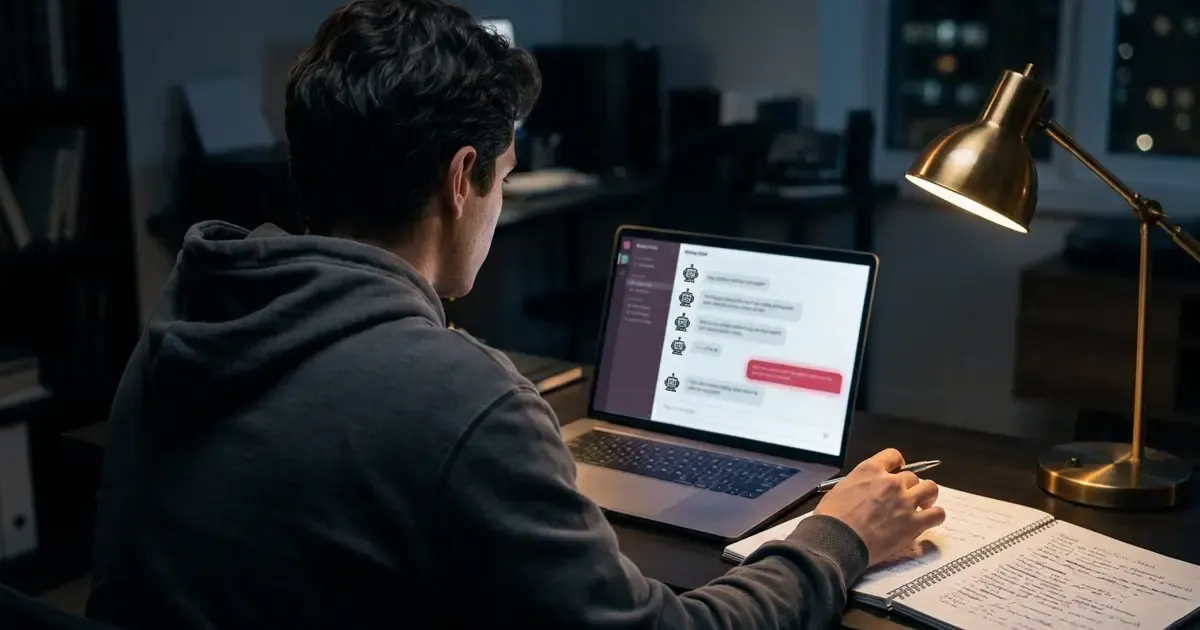
You write your own scripts. It's the slow part, and it's the part you're proudest of. Then on Monday a thread went around saying a fully automated YouTube channel is finally real. A group chat of Grok bots makes the whole video: research, script, fact-check, render, thumbnail, upload. "It is now possible to 100% automate your videos. Yes 100%."
A couple of months earlier, a creator on r/aitubers had said they were glad AI still struggled with scripts, and named the stakes in one line: "If ai can be more creative in script then we slowly become obsolete." (thread(opens in new tab))
This post won't tell you that writing your own words keeps your channel safe from demonetization. It doesn't, and there's a creator further down who learned that the hard way. What it does is read the "100%" pipeline step by step, find the humans still in it, and show why they are standing in the wrong place.
What the 100% pipeline actually automates
The thread is from @wannercashcow(opens in new tab), posted 2026-09-21. It describes every role on a classic YouTube automation team, now played by a bot in one chat. In the author's words: "all the 'members' that normally make up a YouTube Automation team are now in a groupschat so they can communicate with each-other."
The seven steps, condensed:
- A researcher bot picks topics using a YouTube research tool and ChatGPT.
- It passes the topic "most likely to go viral" to the script writer.
- The script writer writes; a fact-checker bot checks it and "builds a file with all resource links."
- The script goes to a video tool that was "trained in 6 minutes" on the channel's branding.
- The video is re-rendered locally in ffmpeg "with an increase of 1% brightness."
- A thumbnail bot makes three options, "judged in Slack by 1 of our team members."
- "Once all is done it will be manually scheduled by a human so it can be reviewed."
The author did set things up first. They wrote the prompts the researcher runs on ("I logged in my personal account on the browser of Grok with set prompts") and installed the channel's branding once. That is real human work, but it's done once for every future video. After that, people come back into the loop only at steps 6 and 7.
Once the prompts are set, every step that decides what a given video says is run by a bot. The humans come back after its script is locked.
The two humans in a fully automated YouTube channel
Both humans sit at points where a video can be stopped. The team member in Slack can pick thumbnail B over thumbnail A. The person scheduling can hold a video back. Neither one can make the video say something it didn't already say.
That's the whole problem with "review at the end" as a role. Review can reject a video, but adding a point of view that late is hard, because by the time the video reaches review, the point of view (or the lack of one) was set in step 3 by a bot briefed by another bot. What the human does at that point is approve it or hold it back.
Step 5 is worth a second look too. The author doesn't say why the video gets re-rendered at 1% more brightness. A change that small is hard for a viewer to notice, so it's probably not there for the audience. Our guess is that it makes each file slightly different from what the tool produced, but the thread doesn't say, and it may have another reason.
The top reply under the thread, from @GunwaniViraj(opens in new tab), makes a fair point: "It has always been possible to automate yt video production but for some people it costs $75 per video and some do @$1.2 per video (considering both videos are 30 minutes long)." YouTube automation used to mean hiring freelancers for each role. The group chat keeps the same org chart and swaps the people for bots, so mostly what changed is the cost per video.
What YouTube's inauthentic content policy actually checks
YouTube's monetization rules allow AI and automation. What they check is whose perspective is in the video, and the policy text says so plainly.
In July 2025, YouTube renamed its "repetitious content" policy to "inauthentic content"(opens in new tab). The same help page lists what is and isn't eligible for monetization. Two lines from it, side by side:
| Not eligible | Eligible |
|---|---|
"AI-generated content made with generic or unoriginal templates giving the impression of mass production without adding the creator's original, authentic insights or perspective" | "Content that utilizes creative tools to assist in delivering a unique, well-researched, or creative narrative, like using AI to edit your video scripts or generate a unique background visual for your content" |
Read the right-hand column again. The allowed example is AI editing your script. The direction of help is the whole difference: your narrative, assisted by a tool, versus a tool's narrative, approved by you.
YouTube's trust and safety VP, Matt Halprin, said the same thing on the company's podcast, as reported by Yahoo Tech(opens in new tab): "If you make it with Gen AI, great. If you make it without Gen AI, that's great too." YouTube's help page adds that if you use automated tools, "the final product must still demonstrate your creative vision." A thumbnail vote in Slack is a thin place to put a creative vision. We went through how the crackdown plays out in practice in YouTube's AI slop crackdown.
Why the script is the step worth keeping
Several creators who work with AI land on the same conclusion: the script is the part that automates worst. Not everyone agrees, but one r/aitubers thread was titled, bluntly, "From my experience you can get away with AI on everything except script."(opens in new tab)
The replies are specific about why. One creator described the model's drafts as "Politician speak": you can tell it's covering the topic, "but you struggle to understand the point that he is making." The same person put a number on it: "what AI gives me to what end up being my final script, id say MAX 20% of it stays." Another runs drafts through three different models and gets "a mix of gold and garbage," then rewrites "the whole thing to give it soul."
So the step a fully automated YouTube channel hands to a bot first is the step practitioners say takes the most human time to fix. If 80% of a draft gets thrown away, the draft mostly gave you something to argue with.
Other people treat the words as valuable too, sometimes the hard way. A creator on r/PartneredYoutube found another channel(opens in new tab) copying their titles, their thumbnails and their whole script, "word for word across 20+ videos," with the script run through an AI voice. The DMCA claims worked, and the copying channel was terminated.
Here's the creator from the top of this post. In another r/aitubers thread(opens in new tab), someone who has been monetized for at least a decade said their whole channel was demonetized over three or four short AI sci-fi stories and has to reapply to the Partner Program. They added: "I write all my own scripts and even teach people how to write on my channel." The visuals and the format still have to hold up, which is its own problem, covered in why most faceless channels feel random.
The reverse workflow breaks in its own way
Say you do it the other way around: you write the post, and the machine does the assembly. That breaks too, and we know because it broke in our own product.
On 2026-09-09 a user pasted a finished post into our app, 77 words in Romanian, punchline and all: a finished text, not an idea. They pasted it into the idea box, and then typed their own visual directions into the scene boxes, down to what one character should be holding.
The tool treated it as a topic and rewrote it. The scene images came back with generic stand-ins, and none of their directions reached a single image prompt. Our other mode would have kept their words but still cut them apart, into roughly even scenes at sentence boundaries, each with an image prompt written for that piece alone. They left without rendering a video.
A finished post needs two things from the tool: keep the words, and read the post as one piece before cutting it up.
Neither of our input modes was built for someone who arrives with the writing already done. One mode treated the text as raw material and rewrote it; the other kept it but cut it into even pieces. So we built a third. ViralFaceless(opens in new tab) now has a Post to Video mode that turns a written post into a Short of 60 seconds or less: you paste a post you already wrote, the voiceover reads your words as written, the visual directions go to the images instead of being read aloud, and you confirm the scene layout and the list of things it found in your post before any credits are spent. It doesn't post anything either; you download the video and publish it yourself.
When you keep the words and hand off the assembly, check that the tool treats your text as finished. A tool that rewrites it has put you back in the Grok pipeline's position: reviewing someone else's script.
Split the work the other way
Run the same pipeline in the other direction and every role keeps a job, in a different place.
| Step | In the "100%" pipeline | Split the other way |
|---|---|---|
Topic | Research bot picks "most likely to go viral" | You pick; research tools narrow the field |
Script | Bot writes, bot fact-checks | You write; a model edits, trims, checks facts |
Visuals and voice | Tool trained once on branding | Tool assembles from your finished text |
Thumbnail | Bot makes 3, human picks 1 | Same. This part automates fine |
Review | Human at the end, can only reject | You already said what you meant; review is a check |
The bottom two rows barely change. The top two flip, and those are the rows YouTube's policy is about.
Who owns the final cut, which we covered in Someone Still Owns the Final Cut, is a question about the last decision. This post is about the first one: where the words come from.
Here's something you can do in the next ten minutes. Open the script of the last video you published. Highlight every sentence you wrote yourself in one color, and every sentence a model wrote that you kept in another. If the second color wins, you're closer to step 7 of the Grok thread than you think, whatever your workflow is called. Pick one video this week and flip it: write the whole thing first, then let a model edit it rather than draft it.
FAQ
Can Grok really automate 100% of a YouTube video?
By the thread's own description, no. Its step 6 has a team member choosing thumbnails in Slack and its step 7 says the video is "manually scheduled by a human so it can be reviewed." Once the author's prompts and branding are set, what it automates for each video is everything that decides what that video says: topic, script and fact-check.
Does YouTube demonetize fully automated channels?
YouTube's Matt Halprin says its policies are "independent of how the content is made." What it doesn't monetize is content that gives "the impression of mass production without adding the creator's original, authentic insights or perspective." The risk for a fully automated channel is that nothing in it adds that perspective.
Is it OK to use AI on my script?
YouTube's own list of eligible content includes "using AI to edit your video scripts." Editing your script is the allowed direction. Having a model write it and you approve it is the direction the policy describes as mass production.
You wrote the words. The tool should not rewrite them.
Approving a script you did not write puts you back at step 7. Post to Video keeps your words as written and shows the scene layout before you spend a credit.
About the Author

Founder at Dimantika
Creator of ViralFaceless. He writes about AI video production, content automation, and practical tools for faceless creators.
View all postsRelated posts
More articles you might like.
Two Posts Sold You Automated Distribution. Neither Number Checks Out
One claim belongs to a product the post never names. The other sits under a paid-partnership label no API can see. Both sold hands-off distribution.

What a Month of Faceless Video Actually Costs
Sixty credits once, then a real per-video cost, against a channel that takes weeks to show impressions. Nobody in the threads does this subtraction, and it is the one that decides whether you can keep going.
The Number You Are Refreshing Exists in Exactly One Screen
Impressions and click-through rate are the numbers everyone stares at to decide whether a new channel is doomed. We tested it: the YouTube Analytics API does not expose either one.