YouTube Video A/B Testing: Hooks Are Cheap. Winners Aren't.
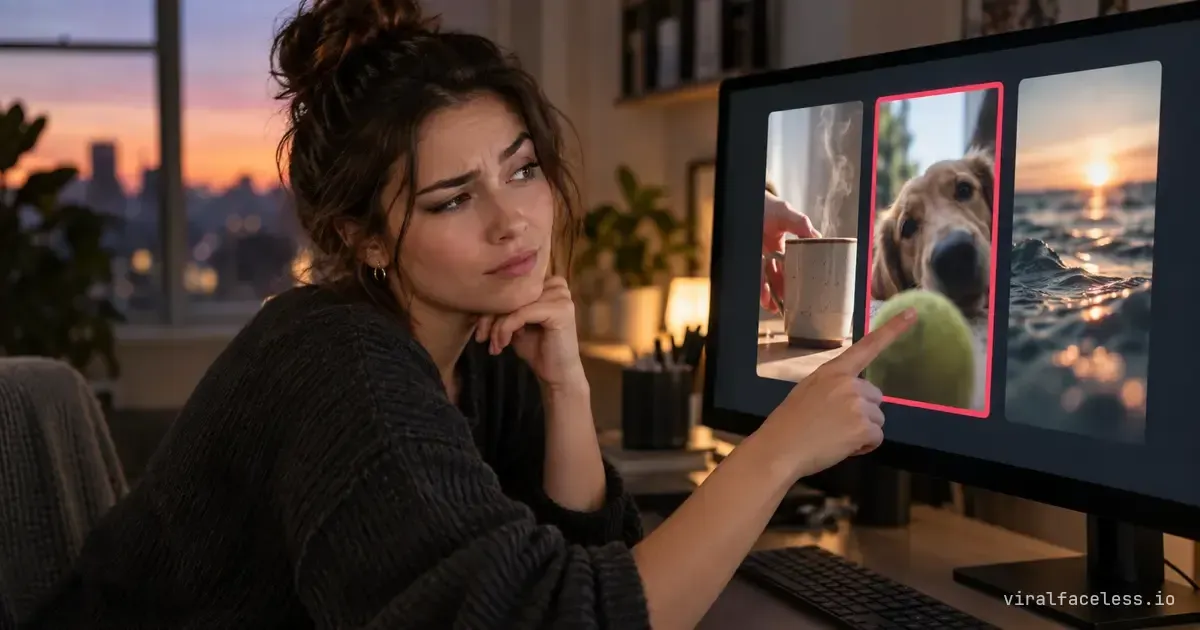
YouTube's own help page for thumbnail tests(opens in new tab) tells you to "run diverse A/B tests," because versions that are "too similar to each other can cause tests to run for longer." When YouTube video A/B testing comes to cuts of a Short, that advice points the wrong way. The Verge reports(opens in new tab) that YouTube's Amjad Hanif says the system keeps the versions from being "dramatically different." Per the same report, the winner is picked on watch time, which counts every difference between the cuts, the hook among them.
For a faceless channel, making three openings is easy. Nobody reshoots anything. Your traffic and YouTube's metric are out of your hands. How much the three cuts differ is up to you, and the useful answer is: only at the opening.
What it won't do: get you early access (YouTube says select creators in 2027(opens in new tab)), or tell you how many views a verdict needs. YouTube doesn't publish that number.
What YouTube announced, and when it arrives
It's announced but not live yet, and YouTube's own account says 2027 for select creators. At Made on YouTube on September 23, 2026, @YouTubeCreators posted(opens in new tab): "with video A/B testing, you can test up to 3 edits of a Short or video simultaneously. review the stats, pick the clear winner, and seamlessly lock it in as your video. launching to select creators in 2027."
YouTube's post says "a Short or video." YouTube's own posts disagree on timing. CEO Neal Mohan's announcement(opens in new tab) says creators "can now" try cuts, while VP Aparna Pappu's post(opens in new tab) says "coming soon." Only the tweet names a date and an audience, so we go with it.
Here is where each claim about the feature comes from:
| Claim | Source | Status |
|---|---|---|
Up to 3 edits of a Short or video | YouTube on X | YouTube's own words |
Select creators, 2027 | YouTube on X | YouTube's own words |
Built to find "which hook performs best" | YouTube blog, Pappu | YouTube's own words |
Winner picked on watch time | The Verge's report | Press report |
Applied automatically after seven days | The Verge | Press report |
Versions can't be "dramatically different" | The Verge, quoting Hanif | Press report |
A longer cut can win on length alone | This post | Our inference, untested |
The new test builds on the title and thumbnail one, where creators have run "more than 40 million experiments(opens in new tab)" since its 2024 launch. That older tool is the best guide to how the new one will behave. Mohan's post puts the new test in Studio. That's where impressions and CTR sit today, and they're not in the Analytics API. Whether the test results will be is unknown.
What decides the winner: watch time, per The Verge
YouTube's blog posts don't name the metric. They say "which holds audience attention best" and "which hook performs best." The metric comes from press coverage. The Verge reports(opens in new tab) that the versions go to small audience segments "to test which results in the highest watch time," and that creators can pick the winner, "or YouTube will automatically do so after seven days." Two write-ups of YouTube's demo agree: 80.lv(opens in new tab) says the report shows "watch time share," and KDCC(opens in new tab) says the winner "will be selected based on watch time share." The thumbnail tool already works this way. Its help page(opens in new tab) says YouTube optimizes "for overall watch time over other metrics, like click-through-rate."
With the "dramatically different" limit from the opening, the thumbnail page's advice to go diverse doesn't carry over to video cuts. You'll be testing openings, with the rest of each cut matching.
Our inference: on a Short, a longer cut can beat a better hook
This part is our reading of the metric. YouTube hasn't said it, and nobody has tested it yet. YouTube's Shorts metrics(opens in new tab) split performance into "Stayed to watch," the share of viewers who watched "past the initial seconds," and average view duration among those who stayed. Total watch time is roughly impressions times that stayed-to-watch rate times that duration.
Three terms multiply into the number the test ranks. Only one of them is about the hook.
A better hook raises the middle term. A longer cut raises the last one. If version B runs longer than version A, B can pile up more total watch time with a weaker opening, and the report could call it the winner. A KDCC recap(opens in new tab) of YouTube's demo says the example allowed versions of different length. If you want the result to say something about your hook, keep the runtimes equal. What length does to a Short on its own is covered in our look at Shorts length.
Why three hooks won't buy a small channel a verdict
Cheap versions don't create impressions. Three versions split one Short's traffic three ways, and each slice has to be big enough to tell them apart. The thumbnail test shows what happens when it isn't.
A creator on r/SmallYTChannel ran eight Test & Compare runs(opens in new tab) on eight videos and got Inconclusive every time. These are the splits they gave as examples:
Every dot sits close to an even split. The creator reported every test as Inconclusive, the 1,300-view one included.
Their videos usually get "a couple dozen to one or two hundred-ish views" in their lifetimes. The one video that broke out, at over 1,300 views, split 28/38/34 and was "still 'inconclusive.'" Their conclusion: "I wonder if I should bother with it anymore."
That's one creator's report. YouTube's help page(opens in new tab) points the same way, though. It says "It's normal not to receive a 'Winner' test result" and lists "Not enough impressions" as one reason. In a second thread(opens in new tab), a creator wrote that "90% of the time my videos don't get enough views to even get results."
Two more details from the help page matter for a video test that settles itself in a week. Early impressions "are more likely to come from viewers who are already familiar with your channel." So a first-week verdict on a new Short is mostly your regulars voting, which is the gap in our post on why videos only reach people who already watch you. And traffic often comes in a burst. A creator in the same thread said, "I usually get about 3 really strong days after publishing, and it feels like by the time it chooses that wave is over anyway."
The Verge also asked whether YouTube had data showing these tools improve creators' numbers. The company "declined to share anything."
How to prepare three cuts for YouTube video A/B testing
Change the opening and nothing else, so the watch-time number can only be about the opening. The feature is slated for select creators in 2027, so there's time to practice, and the habit is useful even if you never get access.
- Change only the hook. Swap the first line, how it's read, or the opening visual. YouTube's own example, via The Verge(opens in new tab), is "a clip with a different intro and hook."
- Keep the body and the length identical. Same scenes after the opening, same end point. Otherwise, going by the inference above, you're testing runtime.
- Put the version you'd ship anyway first. In the thumbnail test, when nothing wins, "the first title or combination of title and thumbnail that you uploaded will be shown to all viewers" (help page(opens in new tab)). YouTube hasn't said the video test does the same. Assume it does until told otherwise, and an Inconclusive costs you nothing.
- Write down what each version changed. One creator in the PartneredYoutube thread(opens in new tab) said the winner "has always been the one I guessed would win." A note on what you changed is how a confirmed guess becomes a pattern you can reuse.
- Start a hook file now. For each Short, draft two other openings, even if you post only one. If the test reaches your channel, you'll already have a list of the openings you believe in, and that's the list to test.
One thing changes between versions. Everything the watch-time number could confuse with the hook stays fixed.
For faceless channels, the risk is the seam. An opening remade on its own can look or sound different from the scene after it, and a viewer who notices may swipe for reasons that have nothing to do with the hook. Watch each version start to finish before you keep it.
If you make Shorts in ViralFaceless(opens in new tab), you can redo the opening scene's visuals and voice and re-render. The wording of the opening line stays as written, so the variants differ in picture and delivery. The other scenes' assets are reused, not regenerated. A re-render replaces the file, so download each version before you make the next one.
FAQ
When will YouTube video A/B testing be available?
YouTube's creator account says it's "launching to select creators in 2027." No wider date has been announced, and there's no help page for it yet.
Does video A/B testing work for Shorts?
The announcement says "a Short or video." That's a change from the current title and thumbnail test, whose help page says "A/B testing is not available for Shorts."
What metric picks the winning version?
Watch time, according to The Verge's report. Write-ups of YouTube's demo, from 80.lv and KDCC, mention "watch time share." YouTube's own blog posts only describe the cut "which holds audience attention best."
Can I test Short hooks before I get access?
Not inside YouTube. Some creators delete a Short and re-upload it with a new opening. One commenter on r/NewTubers says re-uploading(opens in new tab) "can work but it can also just create duplicates that perform the same or worse, especially if nothing about the packaging or hook changed." That's one commenter's view.
Write two other openings for your next Short
Open the script for the Short you'll post next. Under its first line, write two alternatives of about the same length that promise the same video a different way. Post the original. Save the other two in a file with the date and the Short's link once it's up. If the test reaches your channel, that file is your first test. The whole thing takes about ten minutes.
The test judges whatever differs between your cuts. Make that only the opening.
If the length or body changes too, a win may say nothing about your hook. In ViralFaceless you can redo the opening scene's visuals and voice, then re-render. Download each version first.
About the Author

Founder at Dimantika
Creator of ViralFaceless. He writes about AI video production, content automation, and practical tools for faceless creators.
View all postsRelated posts
More articles you might like.
Why AI Videos Go Viral: Same Model, Demo vs Finished Film
Why AI videos go viral, from one creator's numbers: his Seedance demos got 6K to 128K views, his finished film 3.19M. What you can copy, and what you can't.
YouTube Automation Checklist: What a Reviewer Opens First
A YouTube automation checklist you run on the channel you already have, in the order YouTube says its reviewers look, with the policy's own words as the test.

A Fully Automated YouTube Channel Puts the Human Last
A viral thread says Grok now runs 100% of a faceless video. Its own steps say otherwise: two humans, both placed after the words are already decided.