We Tested 50 YouTube Shorts Hook Patterns. Here's What Actually Scores 80+
Most hook templates you read online claim some "secret formula" that scores 80+. We tested 50 of them through our own Hook Grader(opens in new tab) — the deterministic rubric we built for our faceless creators. The results disagree with most of the advice out there.
Only 3 of 50 well-formed hooks scored "Excellent" (80+). The bulk of structurally clean hooks land between 65 and 78 — Strong, but not Excellent. The gap isn't another "open loop" or another adjective. It's a specific stack of features the rubric weights together.
Here's what we found, and how to actually push your hook past 80.
How we tested
We wrote 50 hooks across 5 hypothesized patterns — each pattern represents an opener archetype that shows up repeatedly in faceless YouTube and TikTok feeds. We also threw 5 deliberately weak anti-pattern hooks into the run as a sanity check. We ran each through our Hook Grader's deterministic scoring engine (no LLM judgement — pure feature extraction + weighted rubric).
The rubric scores 4 weighted factors:
- Clarity (27%): Does the viewer instantly understand what the video is about?
- Curiosity gap (28%): Is there an open loop pulling them deeper?
- Specificity (22%): Numbers, timeframes, named niches, currencies?
- Payoff strength (23%): Is there a concrete reward for watching?
Plus an early-hold outlook score (derived, not weighted).
Verdict bands: 80+ = Excellent, 65–79 = Strong, 40–64 = Usable, <40 = Weak.
The data
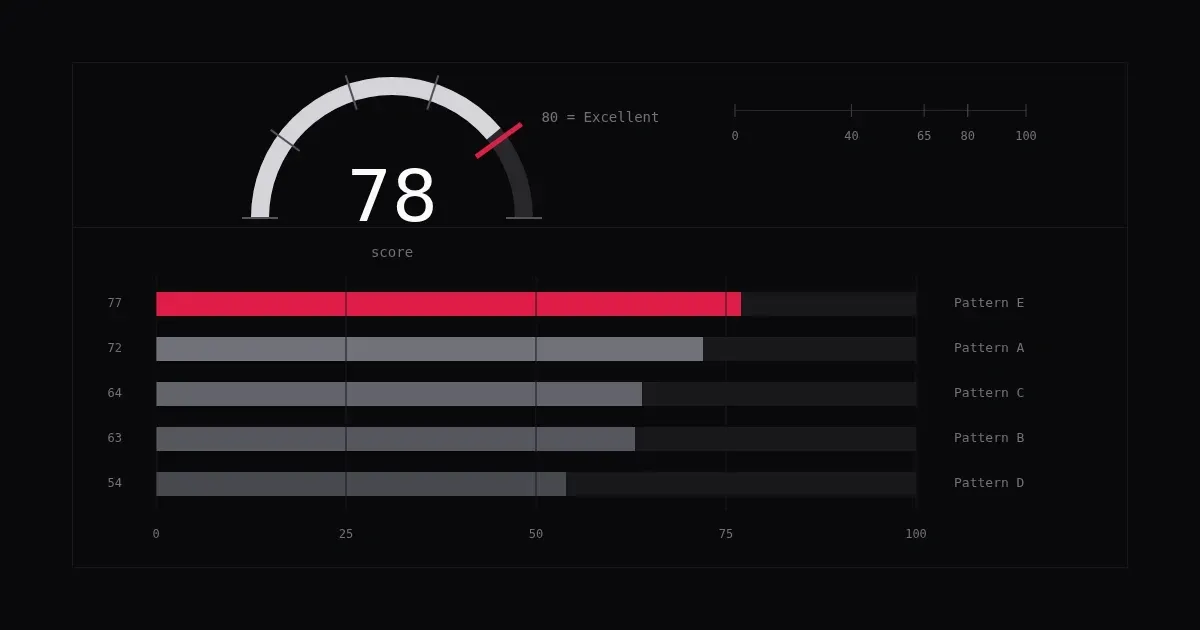
Across 50 hooks, mean score by pattern:
Bar chart of mean Hook Grader score across 50 tested hooks, grouped by pattern (n=10 per pattern). Source: ViralFaceless Hook Grader, internal sample, 2026-05-10.
The clean takeaway: only Pattern E (Currency + Timeframe + Audience + Mechanism) and Pattern A (Number + Niche + Mechanism) put any hooks into the Excellent band. Everything else — including patterns that "feel" strong like contrast and open-loop — peaks in the high-Strong range.
What pushes a hook past 80
Looking at the 3 hooks that scored 80+, they share an exact stack of features:
- Currency anchor —
$1,500/month,$4,200,$1,800/month. Adds 14 to specificity, 10 to payoff. - Timeframe anchor —
in 90 days,in 6 months. Adds 10 to specificity. - Audience signal —
faceless,Shorts,channel,subscribers. Adds 12 to clarity. - Niche subject —
meditation,cooking,fitness. Adds 10 to clarity, 10 to specificity. - Mechanism reveal —
the exact workflow I will show,the exact playbook I will show. Adds 6 to specificity, 7 to payoff. - Method hint —
workflow,playbook,system. Adds 8 to clarity, 15 to payoff.
The Excellent band requires the full stack. Drop any one of currency/timeframe/mechanism, and you fall back to Strong.
A representative Excellent hook from our test (84/100):
"A faceless fitness Shorts channel hit $1,500/month in 90 days using the exact workflow I will show."
Factor scores: clarity 80, curiosityGap 70, specificity 100, payoffStrength 90, retentionOutlook 79.
For deeper context on why these specific elements matter for the first 3 seconds, see how to write a YouTube Shorts script that hooks in 3 seconds.
The 5 patterns we tested, ranked
Pattern E — Currency + Timeframe + Audience + Mechanism (mean 77, 20% Excellent)
The highest-scoring pattern. Combines the most aggressive specificity stack (currency + timeframe + niche) with a mechanism reveal that promises a concrete payoff.
Template: [Niche] [audience] channel [made/hit] $[X] in [timeframe] — here is the exact [system/workflow/playbook] [that got me there / I will show].
Example (84/100): "A faceless fitness Shorts channel hit $1,500/month in 90 days using the exact workflow I will show."
What the rubric is rewarding: the currency anchor + timeframe + mechanism reveal stack hits the rubric's three biggest specificity multipliers simultaneously. The "exact workflow" phrase triggers the mechanism-reveal feature — narrower than a generic "strategy" or "method" and worth +6 specificity, +7 payoff on top.
Pattern A — Number + Niche + Mechanism (mean 72, 10% Excellent)
Strong but not as currency-heavy. Replaces the dollar figure with raw view counts or subscriber numbers.
Template: This [niche] [audience] channel hit [N views/subs] in [timeframe] — here is the [exact system/playbook] behind it.
Example (80/100): "A faceless cooking channel made $1,800/month using the exact playbook I will show."
The trade-off: identical mechanism-reveal hit, but replacing currency with raw numerics drops the specificity boost (no currency anchor = no +14 specificity, no +10 payoff). Most hooks in this pattern peak at 70–77.
Pattern C — Open Loop + Number + Audience (mean 64, 0% Excellent)
The classic YouTube "here's what I learned" opener. Open-loop markers ("here is the one thing", "watch what happens", "I will show you") drive curiosity, but on their own they max out around 70.
Template: Here is the one thing every [audience] gets wrong — and the [fix/change] took my [metric] from X to Y.
Example (71/100): "Here is the secret to faceless thumbnails that took my channel from 200 to 12,000 views per Short."
Where it stalls: open-loop markers add +20 to curiosityGap — the single biggest curiosity boost in the rubric. But specificity and payoff are weighted together at 45% of the overall score, and without a currency or timeframe anchor the specificity component never reaches the 100 ceiling that Excellent hooks hit.
Pattern B — Contrast + Niche + Method (mean 63, 0% Excellent)
The "stop doing X, do Y instead" opener. Contrast markers ("instead", "rather than", "without", "stop") add tension.
Template: Stop [common mistake] — here is the [exact method/setup] that took my [audience] channel to [outcome].
Example (70/100): "Stop chasing CPM — here is the exact monetization setup behind my $3,000/month faceless channel."
The ceiling: contrast adds +12 to curiosityGap — less than open loop's +20. Without consistent timeframe anchors, this pattern sits in the high 60s.
For more on why contrast-driven openers work for retention, see the 7 retention levers we mapped in viral Shorts.
Pattern D — Closed-loop Outcome Alone (mean 54, 0% Excellent)
The "I did X and that doubled Y" opener. Reveals the outcome upfront with a closed-loop payoff verb (doubled, tripled, got me there, made it work).
Template: I [changed X] and that [doubled/tripled/fixed] my [metric].
Example (60/100): "I tightened my first 2 seconds and that tripled my faceless Shorts CTR in 14 days."
Where it leaks: closing the loop in the hook itself fails to lift the curiosity gap above its base value. Specificity is solid (numbers + timeframe), but with no open-loop or contrast marker firing, curiosityGap never lifts above 50. This pattern is better for thumbnails than hooks.
What this means for your scripts
Three rules from the data:
- The Excellent band is a feature stack, not a phrase. Ditch the search for a magic opener. Audit your hook against the 6-feature stack above. Missing one means you cap at Strong.
- Closed-loop outcomes belong on thumbnails, not openers. "I doubled my CTR" is a great thumbnail line. As an opener it kills the curiosity gap. Save the outcome reveal for the body.
- Contrast and open loops are necessary but not sufficient. They get you to Strong (65–79). To break 80 you need to stack them with currency, timeframe, niche, and a mechanism reveal — not just one of them.
The Hook Grader's 80+ band is a real bar. Most hooks circulating online — including the templates in popular faceless creator courses — sit firmly in the 60s. If your hook scores 70, you're already ahead of the pack. If you're hunting for that last 10 points, you need the full feature stack.
Pull up your last 5 scripts. For each opener, count how many of the six features are present: currency anchor, timeframe, niche subject, audience signal, mechanism reveal, method hint. Anything below 4 caps at Strong. Rewrite the lowest-scoring one before your next recording session.
Try it on your own hook
Run yours through the Hook Grader(opens in new tab) — free, no signup, 3 grades per day. The breakdown shows you exactly which factor is dragging your score down and gives you 3 concrete rewrites that target your weakest factor.
If your hook scores 75 and you want to know why it's not 80, the rubric will tell you exactly which feature is missing. We've also written about why most faceless Shorts get views but no subscribers — the hook is only one of several places where the conversion breaks.
A hook opens the video, but the script has to carry it. For what comes after those first seconds, see how to write a Shorts script that hooks in 3 seconds.
FAQ
What does "score 80+" actually mean?
The Hook Grader uses a 4-factor weighted rubric (clarity, curiosity gap, specificity, payoff strength). 80+ lands in the "Excellent" verdict band. Most well-formed hooks score 65–79 (Strong). Excellent requires the full feature stack: currency anchor, timeframe, niche, audience signal, mechanism reveal, and method hint together.
Are these scores predictive of viral performance?
No. The rubric is a structural diagnostic, not a retention prediction. It catches the structural weaknesses that suppress engagement — vague openers, missing specificity, broken curiosity gaps. A high score doesn't guarantee a video pops; a low score nearly guarantees the hook isn't carrying its weight in the first 3 seconds.
Why did Pattern D (closed-loop outcomes) score so low?
Closed-loop outcomes give away the result in the hook itself, so they fail to lift the curiosity gap above its base value. The rubric weights curiosity gap at 28% — second-highest. "I doubled my CTR" is a strong thumbnail line and a weak opener. Save the outcome reveal for the body; lead with the open loop.
Can I push a hook past 80 without a dollar figure?
Pattern A (Number + Niche + Mechanism) hit Excellent without currency, but only with the strongest stack: a large numeric anchor (subscribers or views in the hundreds of thousands), a niche subject, a mechanism reveal, and a method hint together. Most non-currency hooks cap at ~77.
How do I score my own hooks?
Paste your hook into the Hook Grader(opens in new tab). It returns the 0–100 score, a breakdown across all 5 factors, your top 3 weaknesses, 3 rewrites targeting your weakest factor, and a one-line diagnosis. Free, 3 grades per day, no signup.
We're building ViralFaceless(opens in new tab) — a channel OS that grades hooks inline as you write scripts, so you can stop guessing whether a hook will land before you commit to a video. Join the waitlist(opens in new tab) for early access.
Your channel deserves a system
Build a recognizable channel with stronger defaults, better consistency, and a workflow you can repeat
About the Author

Founder at Dimantika
Creator of ViralFaceless. He writes about AI video production, content automation, and practical tools for faceless creators.
View all postsRelated posts
More articles you might like.
Selling Faceless Video as a Service: What Clients Actually Pay
Two sellers, same skill, same deliverable — one earns $37 a video, the other $3,000 a month. The gap isn't craft. It's who signs the invoice.
Your 15-Second Short Isn't the Problem. Stop Cutting.
A dataset of 756,851 AI-generated videos says the 15-second clip is a rounding error. Here is what that number does and does not prove about your channel.
YouTube's 2027 Rules: The Number That Actually Threatens Faceless Channels
The headline is that YouTube doubled the entry bar. If you are already monetized, that number does not apply to you. A different one does, and it is not in the headline.