Why Your Faceless Shorts Lose Viewers in 2 Seconds (and 7 Levers That Fix It)
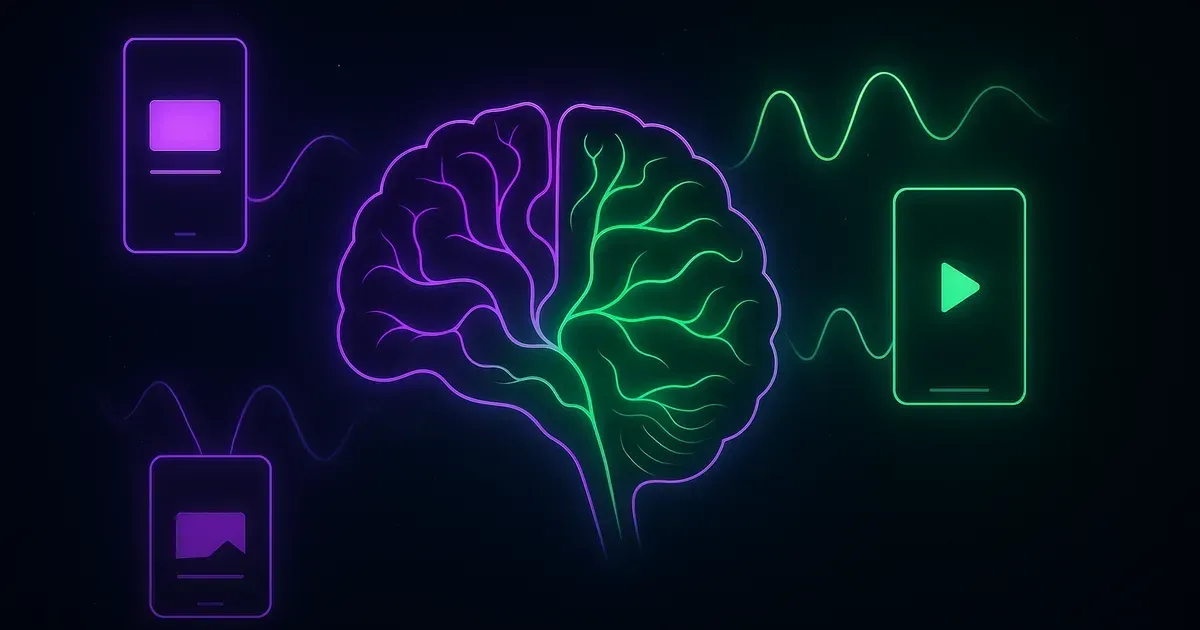
Short-form video is built for speed, but speed alone does not explain why some videos get swiped away in a second while others hold attention to the final frame. The real driver is psychological design. People usually do not finish a Short because they are deeply invested in the topic. They finish because the video creates tension, reduces mental effort, and promises a payoff their brain wants to collect.
For faceless YouTube Shorts and TikTok creators, that is good news. You do not need on-camera charisma to improve retention. You need better structure.
Key Takeaways
- The psychology of viral short-form video is less about “dopamine hacks” and more about closure, anticipation, and cognitive ease.
- The first 1 to 2 seconds decide whether a viewer’s brain commits or scrolls.
- Curiosity gaps outperform pure information when your goal is completion rate.
- Simple videos often retain better than busy ones because they lower cognitive load.
- A reliable faceless framework is: Hook → Open loop → Escalate → Payoff → Optional loop.
Why short-form video feels impossible to stop watching
TikTok users spend an average of around 95 minutes per day on the app globally. That number tells you something important: short-form video is not just entertaining, it is engineered to keep attention moving from one payoff to the next.
The basic loop is simple. Short-form feeds combine novelty, uncertainty, fast pacing, and immediate emotional payoff. Every swipe offers a new chance at surprise. That creates a reward cycle where the viewer keeps scanning for the next satisfying outcome.
But creators often misunderstand what “engaging” means here. It is not constant stimulation. It is expectation.
A viewer keeps watching when their brain predicts that a payoff is coming soon. That payoff could be:
- an answer
- a reveal
- a joke landing
- a transformation
- a shocking comparison
- a satisfying visual result
This is why short-form feels hard to stop. The feed is full of unresolved mini-promises. “Wait for the result.” “See what happens next.” “Watch the final comparison.” Even when the topic is trivial, the brain wants closure.
There is also a broader issue behind this design. Short-form changes the incentive structure of attention. Long-form rewards patience and context. Shorts reward rapid reaction. For creators, that means retention comes from making each second feel like progress, not from adding more information.
If you want more watch time hooks, start with this principle: people finish when they sense a clear payoff ahead and believe it will arrive fast enough to be worth the wait.
The first 1–2 seconds decide whether the brain commits
Most drop-off in short-form happens almost immediately. Platform analytics and creator data consistently show the steepest audience loss in the first few seconds of a video. If the opening feels slow, familiar, or confusing, the viewer scrolls before your idea even starts.
The opening seconds do one job: they answer the brain’s silent question, “Is this worth my next few seconds?”
What makes the brain commit
Three things tend to work best:
1. Pattern interrupts
A pattern interrupt breaks what the viewer expected to see. That could be:
- a bold statement in large text
- an unusual visual
- a contradiction
- an outcome shown before the explanation
Examples for faceless channels:
- “This channel got 10M views with no face and no niche.”
- “Most Shorts fail because the hook is too clear.”
- Show the final result first, then cut to “Here’s how it happened.”
2. Immediate stakes
Stakes tell the viewer why they should care now.
- “If your retention drops at 2 seconds, this is why.”
- “I tested 5 hooks. Only one doubled completion.”
- “This mistake kills faceless Shorts before they start.”
3. Open loops
An open loop creates unfinished business. It gives the viewer a missing piece they now want to close.
Paste a line into the Hook Grader and it checks whether an open loop actually fired, not just whether it sounds like one.
- “There’s one reason this boring video outperformed the flashy one.”
- “The ending is why people replayed this.”
- “Watch what changes at second 12.”
Why viewers scroll
People scroll when the setup asks for too much effort too early. Common mistakes:
- long intros
- branding before value
- vague setup
- too much text at once
- generic “hey guys” openings
- context before tension
Faceless creators often have an advantage here. Without needing to introduce a personality, you can get straight to the claim, visual, or result. In short-form video psychology, speed is not just about editing. It is about how quickly the viewer understands the point.
Curiosity beats information when you want completion
The Zeigarnik effect — a well-documented psychological principle — describes how people stay mentally engaged with unfinished tasks better than completed ones. In plain creator terms: the brain hates loose ends.
This is why useful content does not always retain well. A video can be packed with value and still lose viewers if it resolves too quickly or feels complete too soon. Completion-driven content works differently. It creates a question, delays the answer just enough, and keeps signaling that the payoff is near.
Useful content vs. completion-driven content
A useful version says:
- “Here are 3 tips for writing better hooks.”
A completion-driven version says:
- “I tested 3 hook styles. The worst one is the one most creators use.”
The second version creates prediction. The viewer starts guessing. That guessing is engagement.
How curiosity works without becoming clickbait
Good curiosity is specific and honest. It follows a simple pattern:
Promise
State what the viewer will get.
- “This one edit improved retention by 22%.”
- “The final example explains why most Shorts feel boring.”
Delay
Do not reveal everything at once. Add just enough tension.
- Compare two examples before showing the winner.
- Show the before, not the after.
- Tease a mistake, then explain why it matters.
Payoff
Resolve clearly and fully. If the answer feels weak or unrelated, trust drops.
This is the difference between persuasive structure and bait-and-switch. TikTok engagement psychology rewards suspense, but only when the ending feels earned.
A faceless script example:
“I thought fast cuts were killing retention. I was wrong. The real issue was this single caption mistake. Here’s the clip before. Now watch what happens after I changed one line.”
That script creates a clear loop, delays the explanation, and points to a satisfying reveal.
Simplicity keeps attention alive longer than complexity
Cognitive science research on processing fluency shows that people prefer and understand information more easily when it is simple to process. In short-form video, that matters more than most creators realize.
A lot of Shorts lose viewer retention not because they are boring, but because they are mentally expensive.
If viewers have to work to figure out:
- what the video is about
- who it is for
- what they should focus on
- why the point matters
they leave.
Cognitive load kills retention
Short-form gives you very little time to establish clarity. Too many ideas create friction fast.
Common retention killers:
- multiple points in one video
- heavy context before the payoff
- dense subtitles
- cluttered visuals
- too many cuts that change nothing
- jargon without a simple frame
The best practical rule is this:
One video, one idea, one emotional outcome.
That emotional outcome could be surprise, relief, satisfaction, disbelief, or urgency. But pick one.
Why clear beats chaotic
Some creators assume more stimulation means more engagement. Sometimes the opposite is true. A clean visual, one sharp claim, and a direct script often outperform a noisy edit because the viewer can process it instantly.
For faceless channels, this is especially useful. You can use voiceover, captions, stock footage, screen recordings, or motion graphics, but the message should still be immediately legible.
Try this test before posting: if someone watched your Short on mute for two seconds, would they understand the promise?
If not, simplify.
Dopamine is only part of the story — prediction and payoff matter more
Neuroscience research often points out that dopamine is strongly involved in anticipation of reward, not just reward itself. That is a better way to understand viral Shorts than the lazy “dopamine hack” explanation.
People do not keep watching only because each second is pleasurable. They keep watching because the video teaches them to expect another small reward soon.
What those micro-rewards look like
A strong Short has mini-payoffs across the timeline:
- a caption that sharpens the mystery
- a progress marker like “step 2/3”
- a visual switch
- a reveal of partial evidence
- a stronger comparison
- a countdown
- a near-finished transformation
These are not random editing tricks. They are signals that the video is moving forward.
Variable reward in short-form
Not every reward arrives at the same speed or in the same form. That variability matters. Sometimes the payoff is emotional. Sometimes it is informational. Sometimes it is visual. That mix keeps prediction active.
For example:
- At 1 second: “This dead channel came back in 7 days.”
- At 5 seconds: show the analytics graph rising.
- At 9 seconds: reveal the content change.
- At 14 seconds: explain the hidden reason it worked.
- At 18 seconds: show the exact template.
That sequence keeps rewarding the viewer while preserving the final answer.
In other words, short-form video psychology is not “stimulate constantly.” It is “promise clearly, progress visibly, reward often.”
What faceless creators can copy from viral videos without becoming manipulative
Completion rate and average watch percentage are major signals platforms use to judge whether a Short deserves broader distribution. That makes retention design important. It does not mean you should trick people.
Ethical retention design is simple: create honest tension, move fast, and deliver what you promised.
The faceless retention framework
Use this structure:
Hook → Open loop → Escalate → Payoff
And if possible:
→ Optional loop
HOOK First 2s Pattern interrupt
TENSION Middle Open loop + stakes
REWARD End Payoff delivered
LOOP Last frame Tease what's next
How each step works
Hook
Start with a claim, contradiction, result, or visual surprise.
- “This faceless format gets higher completion than talking-head videos.”
- “I replaced my intro with one sentence and retention jumped.”
Open loop
Create the missing piece.
- “The reason is not what most creators think.”
- “There’s one moment that changes how people watch this.”
Escalate
Add evidence, contrast, stakes, or progression.
- compare before vs. after
- show analytics
- count down
- reveal partial steps
Payoff
Resolve the tension clearly. Give the answer, example, or final visual.
Optional loop
End in a way that naturally invites a replay.
- a seamless loop cut
- a final question
- a quick recap that reframes the opening
Responsible design matters
Long-form trains thinking. Short-form trains reaction. That does not make Shorts bad, but it should make creators more intentional. You can use the same viewer retention mechanics without building misleading content.
A good rule: if the ending would make the viewer say “fair enough,” your retention structure is probably honest.
A practical checklist for making viewers watch till the end
High-performing YouTube Shorts aim for completion rates above 70–76%, with [videos crossing 1M views averaging around 76% retention](https://www.shortimize.com/blog/how-to-analyze-youtube-shorts-performance) according to Shortimize data. The exact benchmark varies by platform and length, but the principle is consistent: the more of your video people finish, the more likely the algorithm is to test it wider.
Here is a practical checklist for faceless YouTube Shorts and TikTok videos.
Short-form retention checklist
- Make the first frame understandable
- Use a visible result, bold caption, or clear visual cue.
- State the promise fast
- The viewer should know what they will get within 1 to 2 seconds.
- Open a loop
- Give them a missing piece to wait for.
- Keep one core idea
- Do not stack three topics into one 20-second video.
- Reduce text friction
- Use short captions. One thought at a time.
- Add visible progress
- Countdowns, steps, comparisons, and “watch this” moments help.
- Change the visual before attention stalls
- Use motion, zooms, cutaways, or graphic shifts with purpose.
- Trim throat-clearing
- Cut greetings, setup, and repeated words.
- Place the payoff before the final second
- Do not wait too long. Leave enough time for the resolution to land.
- Test loopable endings
- If the ending connects smoothly back to the first frame, rewatches can rise.
Remove friction in the edit
When revising a Short, ask:
- Can I cut the first sentence?
- Can this phrase be simpler?
- Does every visual support the same idea?
- Is the payoff obvious enough?
- Would this still make sense without sound?
A faceless scripting template
Use this plug-and-play structure:
[0:00–0:02] Hook:
“Most faceless Shorts lose viewers before the point starts.”
[0:02–0:05] Open loop:
“The weird part is, it’s usually caused by one editing habit.”
[0:05–0:12] Escalate:
Show example A failing. Show example B outperforming. Add on-screen text: “Notice the first line.”
[0:12–0:18] Payoff:
“The winner tells you the outcome first. That lowers effort and creates curiosity.”
[0:18–0:22] Optional loop:
Replay the better hook as the final frame returns to the opening visual.
That is a usable retention structure for explainer channels, Reddit-story formats, AI voiceover channels, screen-recording tutorials, trivia pages, and almost any other faceless setup.
Retention levers assume you already picked a niche that repeats cleanly. If you are still choosing where to compete, the [best faceless YouTube niches for 2026](/blog/faceless-youtube-niches-2026) guide breaks down which niches fit short-form and which pay best.
FAQ
Why do people watch short-form videos till the end?
Because the video creates a fast, clear expectation of payoff. Curiosity, unresolved tension, and visible progress make the brain want closure.
What psychological hooks increase short-form video retention?
The strongest hooks are pattern interrupts, open loops, prediction gaps, high clarity, and frequent micro-payoffs. Simplicity matters as much as novelty.
How do TikTok and YouTube Shorts keep viewers engaged?
They combine endless novelty at the feed level with reward anticipation at the video level. Each Short competes by promising a satisfying outcome quickly.
Is dopamine the main reason short videos go viral?
Not by itself. Anticipation and payoff design explain more than the generic “dopamine hit” theory. Viewers stay when they expect something worth waiting for.
What matters more for faceless creators: information or curiosity?
If your goal is completion, curiosity usually matters more. The best-performing faceless Shorts combine useful information with a structured reveal.
How ViralFaceless checks your script before you generate anything
Reading about retention structure is one thing. Applying it before you spend time generating voices, images, and a final render is another. That gap — between knowing the theory and catching the problems early — is exactly what the ViralFaceless retention analyzer handles.
What it checks
After you generate scenes, the analyzer scores your script 0 to 10 against the five retention beats this article covers: Hook, Open Loop, Progress Markers, Micro-rewards, and Payoff. Each missing beat shows up as a specific finding — not a vague warning, but something like "No open loop detected — add a curiosity gap in scene 2" or "No progress marker in the middle section."
One click to fix it
Clicking "Fix all" or "Repair structure" runs the AI rewrite on problem scenes. It rewrites the text and assigns each scene a narrative role — hook, open loop, payoff, and so on — which shows up as a beat badge on the scene card. The score updates immediately. Most scripts go from 6 or 7 to 9 or 10 in one pass.
The same fix tools are available on the preview page. If something still looks weak after assets are generated, you can repair specific scenes and regenerate only the affected voices without starting over.
Why checking before you generate matters
The usual loop is painful: write a script, generate a video, post it, check analytics a week later, wonder why watch time dropped at second four. The retention analyzer moves that feedback to before generation. You fix the structure when it is fast and cheap to fix — in the script, not the final render.
You do not need to understand retention theory to use it. The score tells you where you stand. The findings tell you what to change. The rewrite button handles the rest.
If you run a faceless channel and want stronger retention, stop asking how to add more effects. Ask how to create a clearer promise, a better open loop, and a payoff that lands fast. That is what makes people watch till the end.
The 7 attention triggers the grader checks for
Everything above is a manual read: you look at a hook and judge whether it opens a loop, breaks a pattern, or gets specific enough to hold attention. The Hook Grader runs the same checks as code, not as a guess. Paste a line and it scans for seven triggers:
- Open loop: Promise a reveal the viewer has to keep watching to get
- Exact number: Anchor the claim with a concrete figure, currency, or timeframe
- Audience marker: Name the niche or the person this is for so they self-select
- Pattern break: Contrast the common approach with the one you actually used
- Mechanism reveal: Signal the specific system or step you are about to name
- Competence check: Tell the viewer most people get this wrong so they check themselves
- Second-person moment: Name the exact situation the viewer is already living through
Fired triggers show as a check. Missing ones come with a one-line note on how to add them. The same detector now grades YouTube titles too: flip the toggle and it judges scan-stop and click-through instead of in-video retention.
It's free, ten grades a day, no signup. Try the Hook Grader.
Your channel deserves a system
Build a recognizable channel with stronger defaults, better consistency, and a workflow you can repeat
About the Author

Founder at Dimantika
Creator of ViralFaceless. He writes about AI video production, content automation, and practical tools for faceless creators.
View all postsRelated posts
More articles you might like.
Selling Faceless Video as a Service: What Clients Actually Pay
Two sellers, same skill, same deliverable — one earns $37 a video, the other $3,000 a month. The gap isn't craft. It's who signs the invoice.
Your 15-Second Short Isn't the Problem. Stop Cutting.
A dataset of 756,851 AI-generated videos says the 15-second clip is a rounding error. Here is what that number does and does not prove about your channel.
YouTube's 2027 Rules: The Number That Actually Threatens Faceless Channels
The headline is that YouTube doubled the entry bar. If you are already monetized, that number does not apply to you. A different one does, and it is not in the headline.