Why Faceless Video Pipelines Break After the Script
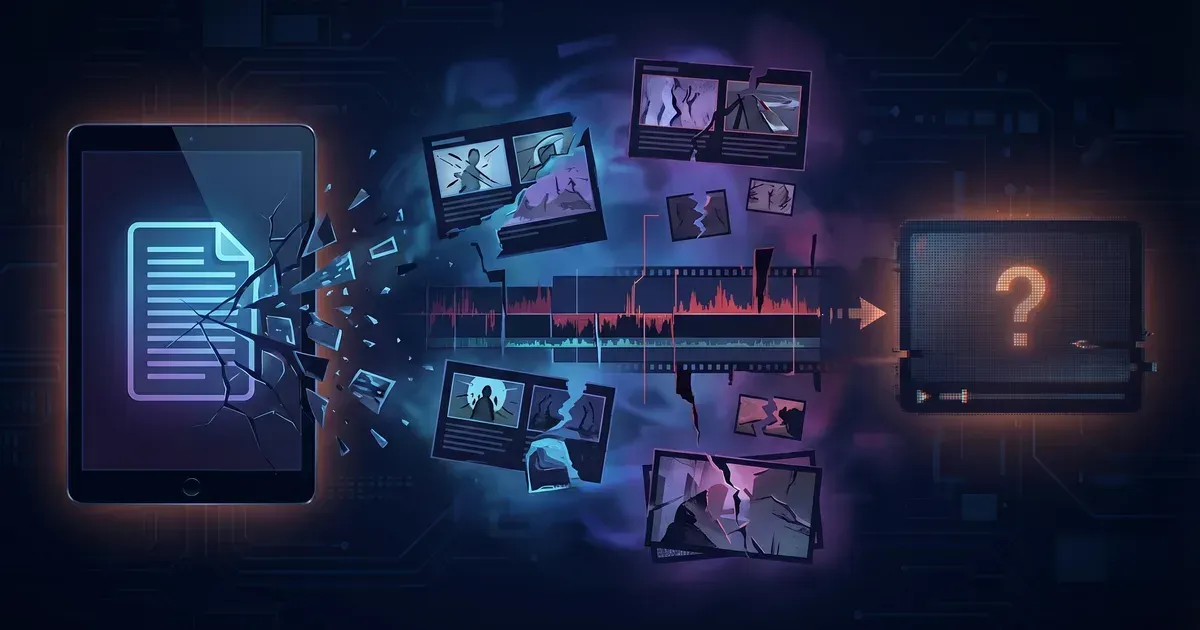
Most faceless creators blame the script first. That sounds reasonable and it is usually wrong. The script often does its job. It sets the hook, frames the idea, and points toward a payoff. Then the pipeline takes over and quietly drains the life out of the video.
Quick Summary:
- A strong script does not guarantee a strong faceless video. Scene choice, pacing, visual consistency, and payoff usually decide whether people keep watching.
- Short-form workflows now reward captions, vertical framing, and cleaner pacing, so execution after the script matters more than ever.
- The better workflow is not script-first alone. It is script, then scene logic, rhythm, visual DNA, and a deliberate watchability check.

The script rarely ranks first. Scene logic and rhythm carry most of the weight.
A viewer never sees your script. They see the rendered sequence. They feel the cut timing. They notice whether the visuals match the words. They decide, almost instantly, whether this looks like real content or another faceless draft that was technically completed but emotionally empty. So where does the breakdown actually happen?
The same opening line can feel sharp in a script doc and dead in the final video. That shift happens because the viewer is judging scenes, timing, caption energy, and payoff all at once.
The Script Is Only a Promise
A script is a promise about what the video is supposed to become. It is not the experience itself. That difference matters more now because short-form viewers have learned to detect weak execution in seconds.
Our finding: In faceless workflows, the script is rarely the last major problem. More often, the script is the last place where the video still feels coherent.
That matches what we keep seeing across the category. A script can open with a sharp curiosity loop and still die on screen because the first scene is generic, the captions lag, the visual energy never builds, or the ending arrives without emotional closure. The script creates intent. The rest of the pipeline decides whether that intent survives contact with the final video.
If you want a simple diagnostic, watch one of your own finished videos with the audio on, then with the audio off, then again while reading the script separately. When all three experiences feel aligned, the pipeline is probably healthy. When one version feels stronger than the others, you've found the handoff problem.
This is also where many creators get trapped. They keep rewriting the script because it's the easiest visible artifact to blame. Meanwhile, the real issues live downstream. The handoff from words to scenes is weak. The edit has no pulse. The visual system changes from shot to shot. So the script gets revised three times while the actual failure stays untouched.
The viewer does not care which stage failed. They only feel that the video lost conviction.
Imagine a line like "Here's why your viewers leave almost immediately." It can look sharp in a script doc and die in the rendered video. If the first frame looks like stock filler, the line loses force before the second sentence lands. That is a pipeline failure, not a writing failure.
Breakpoint 1: Scene Selection Collapses the Story
This is where a lot of faceless videos quietly flatten out. The script says one thing, the visuals say another, and the story loses specificity.
Vertical, voice-led faceless videos are no longer novel. They are baseline category behavior. Once the format itself becomes familiar, viewers stop rewarding mere format compliance. They start judging scene quality, scene relevance, and how tightly each visual beat supports the narration.
Every weak scene falls into one of three buckets. All three drain script specificity.
If the line is specific and the scene is generic, the scene wins. Always. Why? Because video is an embodied medium. People feel mismatch faster than they can explain it.
Here is a simple example. Suppose the script says, "Most AI tools don't fail at generation. They fail at the handoff." That line wants a visual that implies transition, bottleneck, or breakdown. Instead, many videos cut to a random laptop close-up, a glowing dashboard, or a vague office montage. Nothing in that shot sharpens the idea. The image does not add meaning. It only fills time.
A good scene does one of three things. It clarifies the line, it intensifies the line, or it creates contrast that makes the line more memorable. Otherwise it's decoration.
That is why generic B-roll is so expensive. It does not just look dull. It actively erodes the script's precision. Once three or four weak scenes stack up in a row, the viewer stops experiencing the video as a sequence of ideas. They experience it as background sludge.
The creator often misreads the result. They assume the topic was weak, when the real issue was that the visual layer never carried the claim with enough specificity.
If you want to audit this fast, mute any finished faceless video. Then ask a blunt question: do the scenes still tell the same story the script was trying to tell? If not, the failure started here.
For more on this visual mismatch problem, see our breakdown of why the preview looked nothing like the final render.
Breakpoint 2: Rhythm Dies in the Edit
Even when the scenes are decent, the video can still feel dead. That usually means the rhythm collapsed.
Captions are no longer just an accessibility layer. In strong faceless edits, they act as pacing infrastructure. Serious creators are not only adding text. They are building motion, emphasis, and attention cues directly into the edit.
Four ways pacing collapses on the timeline. Each fails in a different beat of the video.
So what goes wrong? Usually one of four things.
First, the cut timing is late. The viewer understands the beat before the edit moves, which makes the whole piece feel slow.
Second, the caption timing is flat. Everything appears with the same emotional weight, even when the line needs escalation.
Third, the visual density never changes. Every scene lasts roughly the same amount of time, so the video has no acceleration.
Fourth, the payoff beat lands with the same energy as setup beats. The ending arrives, but it does not feel earned.
Would a better script fix that? Sometimes a little. Usually not. Rhythm problems live in the distance between beats, not the words inside them.
Our finding: When creators say a faceless video "feels boring," they're often describing rhythm failure, not idea failure. The concept may still be solid. The pacing simply never turns the concept into momentum.
This is one reason short-form psychology advice works only up to a point. Articles like our piece on 7 retention levers help you understand why people keep watching. Those levers only matter if the edit actually expresses them. Curiosity without pacing becomes drag. Closure without escalation becomes a bland conclusion.
A good cut pattern can make a familiar idea feel urgent. A flat cut pattern can make a strong idea feel recycled.
In practice, good rhythm feels like tension being managed on purpose. The viewer gets just enough information, then the sequence moves. The emphasis shifts. A line lands harder because the cut supports it. A caption punches because the timing is doing part of the storytelling. That is editing as narrative, not editing as assembly.
Breakpoint 3: No Visual DNA Means No Channel Memory
A faceless video can be technically correct and still feel disposable. This is where visual DNA comes in.
Most weak faceless channels do not look bad in isolation. They look forgettable in sequence. One video is dark and cinematic. The next is bright and cartoonish. The next uses different framing, different typography, different scene texture, different motion language. The channel never starts to feel like itself.
Google's people-first content guidance stresses original information, first-hand expertise, and substantial added value over recycled output. Source: Google Search Central, 2026(opens in new tab) That principle maps surprisingly well to visual systems. If every video looks like a random assembly of borrowed style cues, the viewer does not experience originality. They experience substitution.
A channel builds memory when repeated aesthetic decisions become recognizable. Not identical. Recognizable.
Visual consistency is not cosmetic. It is structural. It teaches the audience what kind of world they are entering. It increases perceived intention. It lowers cognitive friction. Over time, it helps a faceless channel feel authored instead of assembled.
Repeated aesthetic choices make later videos easier to process because the audience already understands the rules of the channel.
We have already written about the visual rules faceless channels break without knowing. The operational point is simple: the pipeline needs constraints. Color logic. Shot logic. Overlay logic. Lighting logic. Mood logic. Without those defaults, every video starts from zero. That creates more output variance, more revisions, and less brand memory.
If a viewer watches three of your videos and still could not describe what your channel feels like, the script is not the core problem. The visual system never solidified.
Breakpoint 4: The Payoff Never Lands
This is the quietest failure and sometimes the most expensive one. The video holds attention just long enough, then ends without delivering the emotional or cognitive reward the opening implied.
You can think of the script as opening a tab in the viewer's mind. The payoff is what closes it. If the opening promises a reveal, the ending needs a reveal. If the opening promises sharper understanding, the ending needs sharper understanding. If the opening promises relief, the ending needs relief. Otherwise the video feels unfinished even when it technically reaches the last frame.
That is why many faceless videos get described as "fine" but not memorable. The viewer received information, but not resolution.
YouTube itself tells creators to use clear, unique packaging so viewers understand what the video is about. Source: YouTube Help, 2026(opens in new tab) The same logic applies inside the video. Clarity at the front creates a contract. Payoff at the end completes it.
Four endings that look complete but leave the viewer's curiosity loop still open.
Fixable. It requires treating the ending as a design problem, not an afterthought. The best teams plan the final beat with the same care they give the opening hook.
The Better Faceless Video Pipeline
What would a healthier faceless workflow look like?
Faceless video pipeline is the full chain that turns a script into a publishable short, including scenes, captions, pacing, consistency, and payoff.
Start with the script. Just stop treating it as the master artifact that decides everything else. After the script is locked, ask five sequential questions.
- Does every scene sharpen the line it sits under?
- Does the pacing create momentum instead of merely displaying information?
- Does the visual system feel authored across the whole piece?
- Does the ending close the promise made at the beginning?
- Would this still feel watchable among ten similar faceless videos?
That order matters. It mirrors the way the viewer actually experiences the piece. They do not read the script first. They feel the video first.
If you are building a repeatable faceless workflow, this is the checkpoint that deserves more attention than another last-minute script tweak. The sequence gives creators a cleaner QA process. You stop asking vague questions like "is this good?" and start checking specific failure points in order.
In our experience, this is the difference between tools that generate assets and workflows that produce publishable outputs. ViralFaceless(opens in new tab) was built around that exact gap, especially the preview-to-final parity problem and the need for stronger scene-level consistency. Software alone does not solve watchability. It should reduce the places where the pipeline betrays the idea.
Our finding: The winning faceless workflow is not "write a stronger script." It is "protect the original idea through every downstream handoff until the final cut still feels intentional."
That is also why a final watchability pass matters. Watch the finished piece once as a creator, once as a stranger. On the second pass, ask only three questions. Did the first frame earn the opening line? Did the middle keep changing the energy? Did the ending feel inevitable? If any answer is no, the problem is probably not the script.
FAQ
Why do faceless videos fail even with a strong script?
The script is only one layer of the final experience. Scene mismatch, weak pacing, inconsistent visuals, and flat payoff can all destroy a good idea after the writing phase ends. A strong script can still become a weak video if the pipeline fails at execution.
What matters more after the script, visuals or editing?
The order is more useful than the ranking. First the scenes need to support the script. Then the edit needs to create rhythm from those scenes. If the visuals are generic, editing cannot fully save them. If the visuals are strong but pacing is flat, the video still loses energy. You need both, in sequence.
How do I know whether my faceless pipeline is broken?
Run a simple audit. Mute the video and check whether the scenes still express the same story. Then watch with sound and check whether the pacing accelerates or stays flat. Finally, ask whether the ending resolves the opening promise. If the answer breaks at any of those points, you have found the real bottleneck.
We are building ViralFaceless(opens in new tab) to make these pipeline handoffs easier — join the waitlist(opens in new tab) if you want early access.
Sources
Your channel deserves a system
Build a recognizable channel with stronger defaults, better consistency, and a workflow you can repeat
About the Author

Founder at Dimantika
Creator of ViralFaceless. He writes about AI video production, content automation, and practical tools for faceless creators.
View all postsRelated posts
More articles you might like.

Selling Faceless Video as a Service: What Clients Actually Pay
Two sellers, same skill, same deliverable — one earns $37 a video, the other $3,000 a month. The gap isn't craft. It's who signs the invoice.
Your 15-Second Short Isn't the Problem. Stop Cutting.
A dataset of 756,851 AI-generated videos says the 15-second clip is a rounding error. Here is what that number does and does not prove about your channel.
YouTube's 2027 Rules: The Number That Actually Threatens Faceless Channels
The headline is that YouTube doubled the entry bar. If you are already monetized, that number does not apply to you. A different one does, and it is not in the headline.