What Is a Cash Cow YouTube Channel? 16 Honest Answers
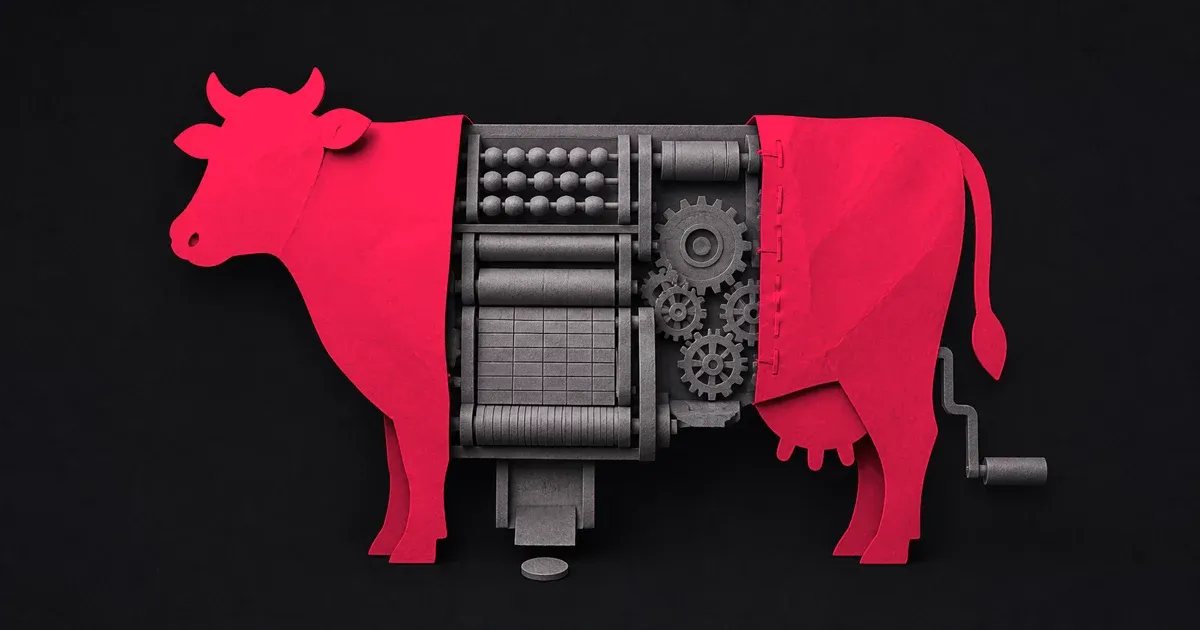
TL;DR: A cash cow YouTube channel is a faceless channel run as a business: AI or freelancers handle production, the owner manages strategy and quality. The model still works in 2026, but only the system-driven version survived YouTube's July 2025 crackdown on mass-produced content.
A cash cow YouTube channel is a faceless channel run as a business asset: production is outsourced or automated, topics come from search data, and the owner manages a pipeline instead of performing on camera. The model is real, heavily marketed, and widely misunderstood — usually by people who just bought a course about it.
This FAQ answers the sixteen questions people actually ask about cash cow channels, organized into four groups:
- The basics — what the term means and where the line with other models runs
- The money — costs, timelines, and why the income screenshots lie
- The build — how to start one and what AI can take over
- Worth it? — the honest verdict for 2026
We run a faceless research channel ourselves and build tools for this workflow, so the answers below come from operating the model, not selling it.
Last updated: June 2026. We revisit this page when YouTube policy or the tooling landscape changes.
The basics
What is a cash cow YouTube channel?
A cash cow YouTube channel is a channel built to generate income with minimal ongoing involvement from its owner: no face on camera, production handled by AI tools or freelancers, and topics chosen by search demand rather than personal interest. The name borrows the business term for a product that produces steady revenue without constant reinvestment. The owner's actual job is running a small content pipeline — strategy, topic selection, and quality control — rather than making videos by hand.
What's the difference between a cash cow channel, a faceless channel, and YouTube automation?
The three terms describe different things that usually overlap in practice. Faceless describes the format, automation describes the workflow, and cash cow describes the business intent.
| Faceless channel | YouTube automation | Cash cow channel | |
|---|---|---|---|
What it describes | Format: no one on camera | Workflow: AI/contractors produce | Intent: channel as income asset |
Can exist without the others | Yes — handmade faceless channels | Yes — automated channel with an AI avatar | Rarely — almost always faceless + automated |
Owner's role | Creator | Pipeline operator | Portfolio manager |
Decisions driven by | Creative interest | Production efficiency | ROI and scalability |
Most channels people call "cash cows" in 2026 are all three at once. We cover the workflow side in detail in the complete guide to YouTube automation.
Are cash cow channels allowed on YouTube?
Yes. YouTube has no rule against faceless, outsourced, or AI-assisted channels. What it prohibits, and started actively enforcing in July 2025, is "inauthentic content": mass-produced, repetitious videos with no original value (TechCrunch(opens in new tab)). A cash cow channel with original scripts, a consistent style, and a real point of view monetizes like any other channel. A channel pumping out template videos that could belong to anyone is the exact profile the policy targets.
Who actually makes money with cash cow channels?
Operators who treat it as a real business: clear niche, documented production system, consistent quality bar, and patience through a long unprofitable ramp. The model rewards people who are good at systems and analytics, not people looking for effortless income. There's a second group that reliably makes money — the people selling cash cow courses and "done for you" channel services. If your introduction to the model came from one of them, assume the numbers you saw were marketing.
The money
How much does it cost to start a cash cow YouTube channel?
In the AI-first version, roughly the cost of two or three tool subscriptions per month plus a lot of unpaid hours. The traditional version — hiring scriptwriters, voice actors, and editors per video — costs an order of magnitude more and is why the model used to require real capital. AI collapsed that entry price, which is also why competition exploded. The real investment in 2026 isn't money. It's the weeks of iteration before your channel finds a pattern worth systemizing.
How long until a cash cow channel makes money?
Longer than any course promises. First, YouTube's Partner Program has hard entry requirements — subscriber and watch-time thresholds you can check on YouTube's official eligibility page(opens in new tab). Second, most channels need a substantial video library before the algorithm distributes them reliably, and YouTube increasingly evaluates your channel as a whole, not video by video. Treat the first months as R&D with zero revenue. If your budget or patience can't survive that ramp, the model isn't for you.
How much do cash cow channels actually earn?
There is no honest universal number. Revenue depends on niche CPM, audience geography, format mix, and how many of your views come from monetizable sources — the spread between two channels with identical view counts can be enormous. High-CPM niches like finance and tech pay multiples of entertainment niches, which is why niche choice matters more than production polish. Anyone quoting a universal dollars-per-month figure for "a cash cow channel" is compressing all of that variance into an ad for something.
Why do most cash cow channels fail?
They optimize output volume instead of a recognizable system, and the platform now punishes exactly that. The typical failure: pick a trending niche, buy a tool stack, publish thirty template videos, get a few hundred views each, run out of motivation. We've written about why volume without a pattern doesn't compound and how template-driven channels hit the slop tax. The July 2025 policy turned that quality problem into a monetization problem too.
The build
How do I start a cash cow YouTube channel?
Pick the niche first, define what the channel promises, then systemize production — in that order. The practical version: choose one niche from the current faceless niche rankings you could cover for 100 videos, write the channel promise in one sentence, produce the first few videos with AI assistance but full human judgment, and only then lock your defaults into a repeatable system. Buying the automation stack before you know your channel's pattern produces polished videos nobody searched for.
Which niches work best for cash cow channels?
Niches that combine searchable demand, high advertiser value, and content you can produce repeatably with a text-to-video workflow. Finance, tech explainers, and how-to content are the classic high-CPM picks; story-driven and curiosity formats trade lower CPM for bigger volume potential. The repeatability test matters most: if a niche needs original footage you can't generate, it doesn't fit this model. Our faceless niche guide ranks the current options with the shorts-fit and repeatability filters applied.
What are some cash cow channel ideas to start with?
Good cashcow channel ideas usually come from niches with steady search demand and formats you can repeat without burning out. A few that people start with: finance explainers, AI tool walkthroughs, history and mystery stories, and "top 10" style fact compilations. The spelling varies (some people write it cashcow, others cash cow), but the idea is the same: a channel built to run on a repeatable system rather than your personal presence. Pick an idea you can produce fifty times, not one you can produce twice.
Can AI run a cash cow channel end to end?
No — and the channels that try are the ones the 2025 policy update was written for. AI reliably covers six of the eight production tasks: voiceover, captions, assembly, thumbnails drafts, script drafts, and publishing. Strategy and judgment stay human: what the channel promises, which hook to pick, and whether a finished video meets your bar. We map the full split in what you should never automate. The working model in 2026 is semi-automation: AI executes, you decide.
Do I need freelancers, or can AI replace them?
For most solo operators in 2026, AI has replaced the freelancer layer for production tasks — voiceover, editing, and captions no longer need per-video contractors. Where humans still earn their fee is judgment work at scale: if you run multiple channels, an editor who guards quality across all of them is worth more than any tool. One caution if you go full-AI: a stack of disconnected single-purpose tools recreates the coordination problem freelancers had, just cheaper. We call it the tool-chain tax, and it is why we built ViralFaceless(opens in new tab) around one system with locked channel defaults instead of another point tool.
Worth it?
Are cash cow channels still worth it in 2026?
Yes, with a smaller and more honest version of the promise. The opportunity — one person running a real media asset with AI doing the heavy lifting — has never been more accessible. What's gone is the lazy version: template content, zero judgment, passive income in eight weeks. The viable 2026 model needs a niche you can sustain, a recognizable style, and an owner who stays in the loop on strategy and quality. That's a real business with real margins, not a money printer.
Is "passive income" from a YouTube channel real?
Mostly no, and the word "passive" causes more failed channels than any tool choice. Even a well-systemized channel needs weekly owner hours for topics, script review, and the quality pass — and YouTube's signals reward viewer satisfaction, which no fully hands-off pipeline maintains for long. What the model genuinely offers is leverage: hours that used to go into editing now go into decisions. Old videos do keep earning, and a working system does compound. That's the honest version of "passive."
What should I do first, today?
Pick your lane and write one sentence. Choose a niche you could cover for 100 videos, then write the channel promise: who it's for and what they get every time. That sentence is the foundation; tools, style, hooks, and cadence all get built on it. If you want the full sequence from there, start with the YouTube automation guide and the niche rankings.
Related resources
- The Complete Guide to YouTube Automation in 2026 — the workflow side: what to automate, what to keep human.
- 7 Best Faceless YouTube Niches in 2026 — niche rankings with repeatability and shorts-fit filters.
- The 5-Node Strategy for Faceless Channels — the system map from promise to feedback loop.
- Best Faceless Video Tools in 2026 — honest tool comparison for the production layer.
- YouTube Partner Program eligibility(opens in new tab) — the official monetization requirements.
- AutoShorts vs ViralFaceless — the autopilot route: hands-off posting versus operator-reviewed automation.
Still have questions?
We update this FAQ as YouTube policy and the tooling change. If your question isn't here, reach out(opens in new tab) — and if you want the system layer handled for you, start free(opens in new tab): 60 credits on signup, no card. They are not renewed.
Sixteen answers, and the seventeenth is whether you can repeat it.
Cash-cow channels fail on the same thing that kills every other kind: the second month. Consistency is what turns a working format into an asset rather than a good week.
About the Author

Founder at Dimantika
Creator of ViralFaceless. He writes about AI video production, content automation, and practical tools for faceless creators.
View all postsRelated posts
More articles you might like.

Two Posts Sold You Automated Distribution. Neither Number Checks Out
One claim belongs to a product the post never names. The other sits under a paid-partnership label no API can see. Both sold hands-off distribution.

What a Month of Faceless Video Actually Costs
Sixty credits once, then a real per-video cost, against a channel that takes weeks to show impressions. Nobody in the threads does this subtraction, and it is the one that decides whether you can keep going.

The Number You Are Refreshing Exists in Exactly One Screen
Impressions and click-through rate are the numbers everyone stares at to decide whether a new channel is doomed. We tested it: the YouTube Analytics API does not expose either one.