The AI Video Factory: Where It Actually Breaks
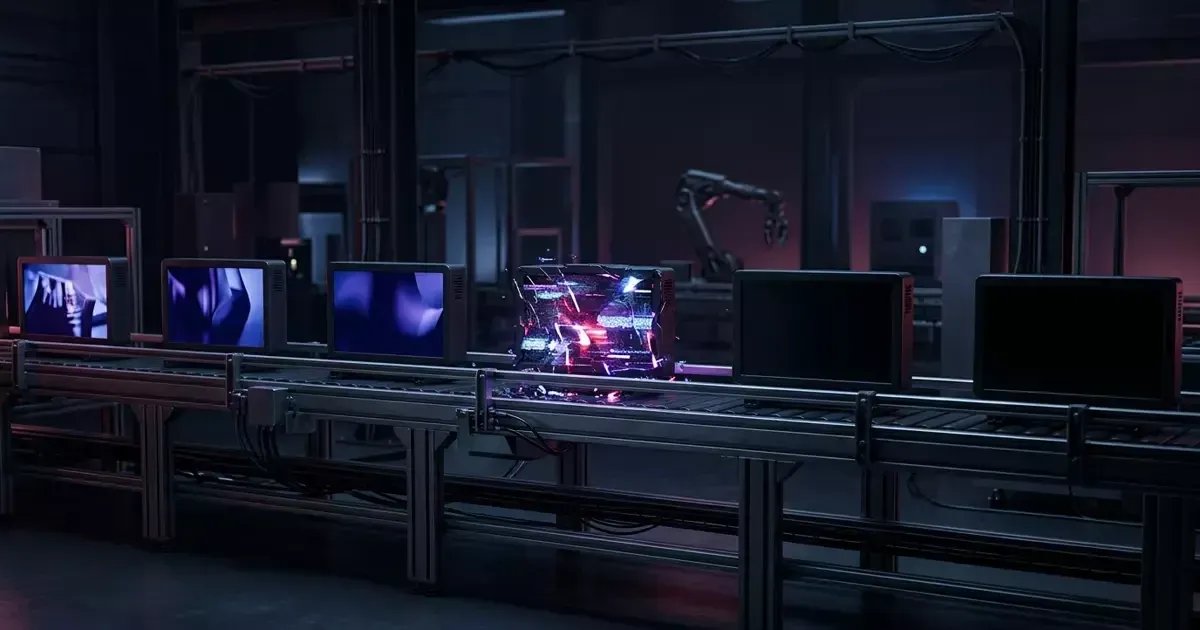
TL;DR: The fully automated AI video factory (ChatGPT writes the idea, Veo 3 renders it, FAL stitches and stores it, no editor, no effort) is real, and the front half works. It breaks in four predictable places: sameness, the missing taste layer, the retention cliff, and platform rules on mass-produced content. Knowing where it breaks is the whole skill.
A post went around in mid-June that captured the dream perfectly. Julian Goldie laid out an "AI VIDEO FACTORY": ideas auto-generated with ChatGPT, sent to Veo 3 plus the FAL API, then auto lip-synced, rendered, and stored. No editor. No effort (@JulianGoldieSEO, June 15, 2026(opens in new tab), about 420 likes and 300 replies).
It's a clean idea, and the appeal is obvious. Push a button, get a video, repeat forever. For a faceless creator whose whole model is removing manual steps, this is the endgame.
Here's the honest version. The factory is real. A lot of it works better than it had any right to a year ago. But it breaks in specific, knowable places, and none of them are the part everyone obsesses over (the render). The render is the easy 80%. The places it breaks are the 20% that decides whether a channel survives.
What the factory genuinely does well
Give it credit first, because the credit is earned.
The generation layer is no longer the bottleneck. Veo 3's visual quality is strong enough that the failure mode shifted from "obviously fake" to "subtle, the kind of thing only a careful viewer catches" (VIDEOAI.ME, Google Veo 3 Review 2026(opens in new tab)). Native synced audio comes out of the same generation, so you skip a whole tool. Over 40 million AI videos have reportedly been made with Veo 3 since its May 2025 launch (CNET, via MagicLight(opens in new tab)). The floor for "good-looking clip" is now low, and the volume is enormous.
Orchestration is also real. Tools like the FAL API chain the steps (prompt in, clip out, lip-sync applied, file stored) without a human dragging anything across a timeline. The plumbing works. If your only goal is "produce a watchable 8-second clip with no manual editing," the factory delivers that today. (The cost of stacking all those tools is its own conversation, which we covered in the faceless tool-chain tax.)
So the hype isn't a lie. The front half of the pipeline, idea to rendered clip, is solid. The trouble starts at everything after the clip.
Break #1: Sameness, and the detectability problem underneath it
The first crack is that everyone's factory produces the same factory output.
When ideas come from the same models, prompted the same way, rendered by the same engine, the results converge. Not identical, but adjacent: the same lighting, the same pacing, the same "AI-cinematic" sheen. A viewer scrolling Shorts doesn't need to consciously detect AI to feel that a clip is interchangeable with fifty others. The sameness is the tell.
There's a measurable side to this too. Google's SynthID watermark is invisible to viewers but real, and it only detects content from Google's own models (AI Free API, Veo 3.1 Watermarks & SynthID(opens in new tab)). It doesn't work as cover either. It marks a clip for detection; it doesn't hide that the clip is AI-made. What actually marks your channel is the human pattern behind it: same template, same cadence, no variation.
This is the wall we wrote about in the faceless YouTube reused-content problem. The factory makes hitting that wall faster, not slower.
Rough illustration: the generation steps are reliable; the breakage clusters after the clip is made. Bars are directional, not measured.
Break #2: There's no taste layer
The factory automates production. It does not automate judgment, and judgment is what was actually scarce.
Picking which idea is worth making, which of four takes is the keeper, where to cut, what to kill before it ships: that's the taste layer. The factory has no opinion. It renders whatever it's told with equal confidence, including the boring stuff. A human editor's real job was never dragging clips. It was saying no to the weak ones.
This is the gap honest reviews keep naming. AI models "generate footage, not finished videos," and there's "a real gap between a gorgeous 8-second clip and a complete, on-brand" video with a consistent voice, script, and point of view (VIDEOAI.ME(opens in new tab)). The factory crosses the production gap and walks straight into the taste gap.
This is the right place for a tool like ViralFaceless(opens in new tab) to sit: not as another full-auto button, but as the quality layer between raw generation and publish, where you choose the script, voice and visuals and decide what's good enough to ship instead of posting every render. Full-auto removes the wrong step. The render was never the hard part.
Break #3: The retention cliff doesn't care that it was automated
A clip that nobody watches to the end is a problem the factory can't see.
Automated pipelines optimize for output. The platform rewards retention. Those aren't the same axis. You can render a hundred technically clean clips a week and still watch the audience bail in the first three seconds, because the factory has no feedback loop tied to whether anyone actually stayed.
The pipeline is built to finish, not to land. A render that finishes feels like success. A render that no one watches is invisible to the factory but very visible to the algorithm. Likely the most important signal, whether the hook holds, is the one piece full-auto has no way to measure on its own.
The scene can also just not match the line. The script says something specific, the render cuts to a generic laptop close-up or a stock office montage, and the viewer feels the mismatch before they can name it. The line loses force right there.
Or the cut doesn't carry the words. A render can nail every individual scene and still feel flat if cuts land late, captions arrive with no escalation, and every shot runs the same length. Nothing in it accelerates.
Or the ending doesn't close what the opening opened. Promise a reveal in the hook and the last beat has to deliver one, not just stop. A video that reaches its last frame without paying off the opening line reads as unfinished, even though the render technically completed. (All setup, no payoff, is the same failure mode we cover for hooks in how to write a Shorts script that hooks in 3 seconds.)
The render is fine in all three cases. The viewing breaks, and that's what the retention chart measures. (A different kind of mismatch, where the preview you approve isn't what renders, lives in You Approved the Preview.)
Break #4: Platforms have rules about exactly this
The last break isn't technical. It's policy, and it's already being enforced.
On July 15, 2025, YouTube clarified its monetization policy on what it then called "inauthentic content" (the section is now titled "Generic or Repetitive Content" on YouTube's page), defined as mass-produced or repetitive content "that looks like it's made with a template, or that may feel repetitive to viewers after watching several videos in a row from the same channel" (YouTube Help, Monetization policies(opens in new tab)). YouTube called the change a "minor update" to its long-standing rules; press coverage tied it to the flood of AI slop (TechCrunch, July 2025(opens in new tab)).
Two details make this sharp for factory operators. First, the tool is irrelevant: YouTube evaluates the output, not the tool, so AI is fine as long as it isn't templated and mass-produced (vidIQ, Reused Content Policy(opens in new tab)). Second, enforcement is channel-level: if reviewers decide your uploads are mass-produced, monetization can be suspended for the whole channel, not just the offending videos (vidIQ(opens in new tab)). The very thing that makes the factory efficient, identical templates at scale, is the thing the policy describes.
That doesn't mean AI video is banned. It means the factory's default output sits closest to the line the policy draws.
So is the factory worth running?
Yes, if you treat it as the front half of a pipeline, not the whole thing.
Here's the whole article in one table: what to automate, and where to keep a human in the loop.
| Pipeline stage | Factory verdict | What you do about it |
|---|---|---|
Idea + render | Works well | Let it run — this is the cheap, fast 80% |
Orchestration (FAL chaining) | Works well | Let it run — the plumbing is solid |
Sameness / detectability | Breaks | Add variation so output doesn't converge with everyone else's |
Taste layer (what to ship) | Breaks | Keep a human (or quality gate) that says no to weak renders |
Retention | Breaks | Watch the hook; feed results back into the next batch |
Platform rules | Breaks | Avoid templated-at-scale; that pattern is named in YouTube policy |
The plain read: use the factory for what it's genuinely good at (fast generation, cheap iteration, killing the worst manual steps), and put your own effort exactly where it breaks. Add variation so your output doesn't converge with everyone else's. Keep a taste layer that says no. Watch retention and let it steer the next batch. Stay clear of the templated-at-scale pattern the platform calls out by name.
One concrete check before you ship: mute the clip and ask whether the scenes alone still tell the script's story. If they don't, that's the scene-mismatch break. Then watch it with sound and ask three questions: did the first frame earn the opening line, did the pacing keep changing, did the ending feel earned. A no on any of the three tells you which break hit that render.
The creators who'll do well with this aren't the ones who automated the most. They're the ones who automated the boring 80% and spent the freed-up time on the 20% the factory can't touch.
FAQ
Is the fully automated AI video factory real, or just hype?
It's real, and the generation half works well. ChatGPT-to-Veo-3-to-FAL pipelines produce rendered, lip-synced clips with no manual editing. The hype isn't the existence of the pipeline. It's the claim that "no editor, no effort" is enough to build a channel. Generation is solved; judgment, retention, and platform fit are not.
Will YouTube demonetize AI-generated videos?
Not for being AI. YouTube evaluates the output, not the tool, and AI content is allowed when it's original and not mass-produced (vidIQ(opens in new tab)). What gets flagged is templated, low-variation, easily-replicated-at-scale content under that policy, and enforcement is at the channel level, so one pattern can affect everything you've uploaded (YouTube Help(opens in new tab)). The factory's default output is closest to that line, which is why variation matters.
What's the one thing full automation can't replace?
The taste layer: deciding which idea is worth making, which take is the keeper, and what to cut. Reviews put it plainly: current models "generate footage, not finished videos" (VIDEOAI.ME(opens in new tab)). The render was never the scarce resource. Judgment was.
We built ViralFaceless(opens in new tab) to sit in that gap: the quality layer between raw generation and publish. Start free(opens in new tab): 60 credits on signup, no card. They are not renewed.
A tool can make the video. The channel is a separate problem.
ViralFaceless saves a channel's default image style, voice and caption mode, so each episode starts from the same settings instead of a blank prompt.
About the Author

Founder at Dimantika
Co-founder of Dimantika. Builds Clipwright and ViralFaceless with coding agents. Previously ran GlockSoft with a partner for about 15 years. Writes about products and finding customers.
View all postsPart of: AI video tools and models
More articles you might like.
Best Faceless Video Tools in 2026: An Honest Comparison
An honest comparison of the best faceless video tools in 2026 and which one actually fits running a channel, not just making a clip.

YouTube Video A/B Testing: Hooks Are Cheap. Winners Aren't.
YouTube video A/B testing reaches select creators in 2027. Three hooks are easy to make for a faceless channel. A verdict you can trust is the hard part.
Your 15-Second Short Isn't the Problem. Stop Cutting.
A dataset of 756,851 AI-generated videos says the 15-second clip is a rounding error. Here is what that number does and does not prove about your channel.